




A pilot proves out. The model works, the demo lands, and the board approves scaling it across the business. Then the data team explains why that is not so simple. The pipeline behind the pilot cannot carry production volume. Half the source systems the new use case needs do not speak to each other. The same customer and the same product show up as different records in a handful of applications because no one owns a single master data repository, and nobody has the authority to say which version is correct. The use case did not fail. The data foundations underneath it, the infrastructure, the interoperability, the governance, did.
Every board wants an AI win
Every board wants an AI win. Almost none ask what happens when it works. The pressure to show something live is real, and it lands on whichever team can move fastest, which is rarely the team that owns the infrastructure the win will eventually run on. So the question gets skipped: if this use case scales past the pilot, what does it run on?
That question is not a technical footnote. It is the difference between a use case that stays a demo and one that changes how the business operates.
The decade of unfinished work AI landed on
Most companies spent the last decade still building their data foundations, and the AI wave hit before that work was done. AI does not remove the need for foundations, it just arrived on top of unfinished ones.
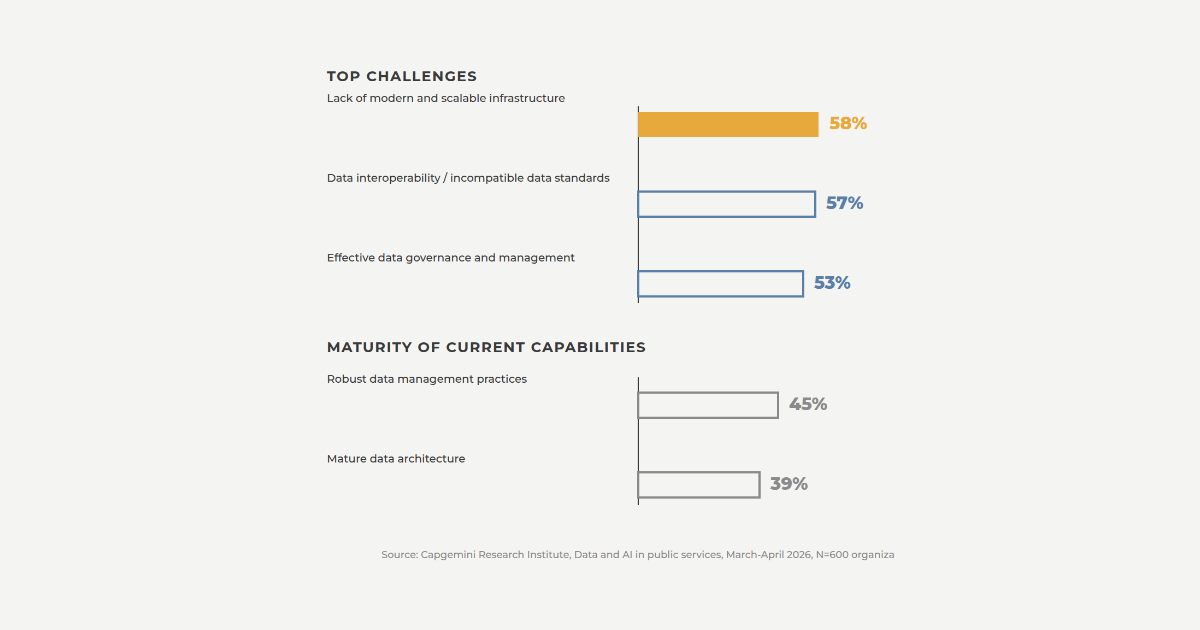
The Capgemini Research Institute’s study on data and AI in public services (March-April 2026, 600 organizations) puts a number on the gap. Asked to name their top challenges in leveraging data, 58% of respondents cited a lack of modern, scalable infrastructure, 57% cited data interoperability and incompatible data standards, and 53% cited effective data governance and management. Asked separately how mature their own capabilities actually are, only 45% called their data management practices robust, and just 39% called their data architecture mature.
Read those two sets of numbers side by side. The gap between what organizations say is holding them back and what they admit is still immature is not a rounding error. It is the foundation the next AI use case is waiting on.
What to do first
None of this is an argument for slowing down on AI. It is an argument for doing two things at once instead of one thing at a time.
Keep exploring AI use cases. The technology is worth testing against real business problems, and the only way to know which use case is worth scaling is to try several. Stopping that work to fix infrastructure first just delays the win by a different route.
Invest in data foundations in parallel, so that when a use case wins, it is ready to carry the load the moment someone asks for it at scale. A use case that proves out and then waits eighteen months for the data platform to catch up loses the momentum that got it approved in the first place.
Fund the data foundation alongside the AI use case portfolio, not project by project. Data infrastructure funded one pilot at a time gets built to the shape of that pilot, then rebuilt for the next one, and rebuilt again for the one after that. Funded at the portfolio level, where the business value is actually delivered, it gets built once, for the use cases that are coming, not just the one in front of you this quarter.
Fund it like a portfolio, not a pilot
The data foundation needs its own budget line, and that line belongs inside the AI use case portfolio, not attached to any single pilot. The portfolio is where business value is easiest to demonstrate to the board; a foundation argued pilot by pilot has no such case behind it and loses the argument every time. Negotiate the budget at the portfolio level, secure a line inside it for the foundation.
Putting the data foundation on the same budget line as the use case portfolio changes who has to answer for the gap. It stops being an IT request competing against a business case, and starts being part of the business case.
The use case that wins is only as good as what is underneath it
The use case that wins is only as good as the foundation waiting underneath it. Boards that fund AI exploration and data foundations together do not slow their AI work down; they are the ones whose winning use case is actually ready to scale when it wins.
When your next AI pilot proves out, is your data foundation ready to carry it, or still on the to-do list?

0 Comments